Metal, Hardcore, Indie, Rock
Live report: Tiamat, Empyrium and more open Prophecy Fest 2026 inside the Balver Höhle
With a transfer booked from Düsseldorf city, getting to Balve on a lovely Thursday afternoon proved remarkably straightforward. Despite heavy rains churning up the region hours earlier, we were surprisingly greeted by a cosy 20°C, brilliant sunshine and a gentle breeze.
Finding the check-in was effortless; one simply had to follow the flock of battle vests and clear “Prophecy Fest Check-In” signposts, guided expertly along the way by more-than-helpful parking staff who kept everything running smoothly. A swift wristband exchange via QR code allowed for a quick grocery run for snacks and drinks before heading off to the hotel.
A massive note of personal appreciation goes out to the lovely lady working in the parking area on Thursday, whose calm presence and assistance in navigating to my hotel truly saved the day.
A crucial piece of advice for future travellers: book months in advance if you plan on attending Prophecy Fest. Local accommodation vanishes instantly, meaning many attendees stay further out and must rely on cabs or rental cars from regional hubs like Dortmund, Düsseldorf, Cologne or Frankfurt.
Thursday’s Prophetic Overture
Returning to the meadow for Thursday’s Prophetic Overture, securing a welcome festival cup for just €2 unlocked the legendary all-you-can-drink beer evening. The local ale was an absolute triumph; and while the wheat beer was crisp and citrusy, even if not quite to my personal taste, it kept spirits high as the sun set in a breathtaking, fiery display over the landscape.
The opening campfire session by Nest felt completely otherworldly, bathed in the scent of barbecue and surrounded by kindred spirits until the meadow felt like a giant, intimate house party. Neun Welten followed with a poignant celebration of “20 Years of Vergessene Pfade”, prompting the crowd to close their eyes, drink and lose themselves in the acoustic intimacy of the moment.
Between sets, the free beer queue stretched endlessly, though the crowd quickly scrambled back to their standing spots to welcome Simone Salvatori from Spiritual Front for a brilliant, entrancing solo performance.
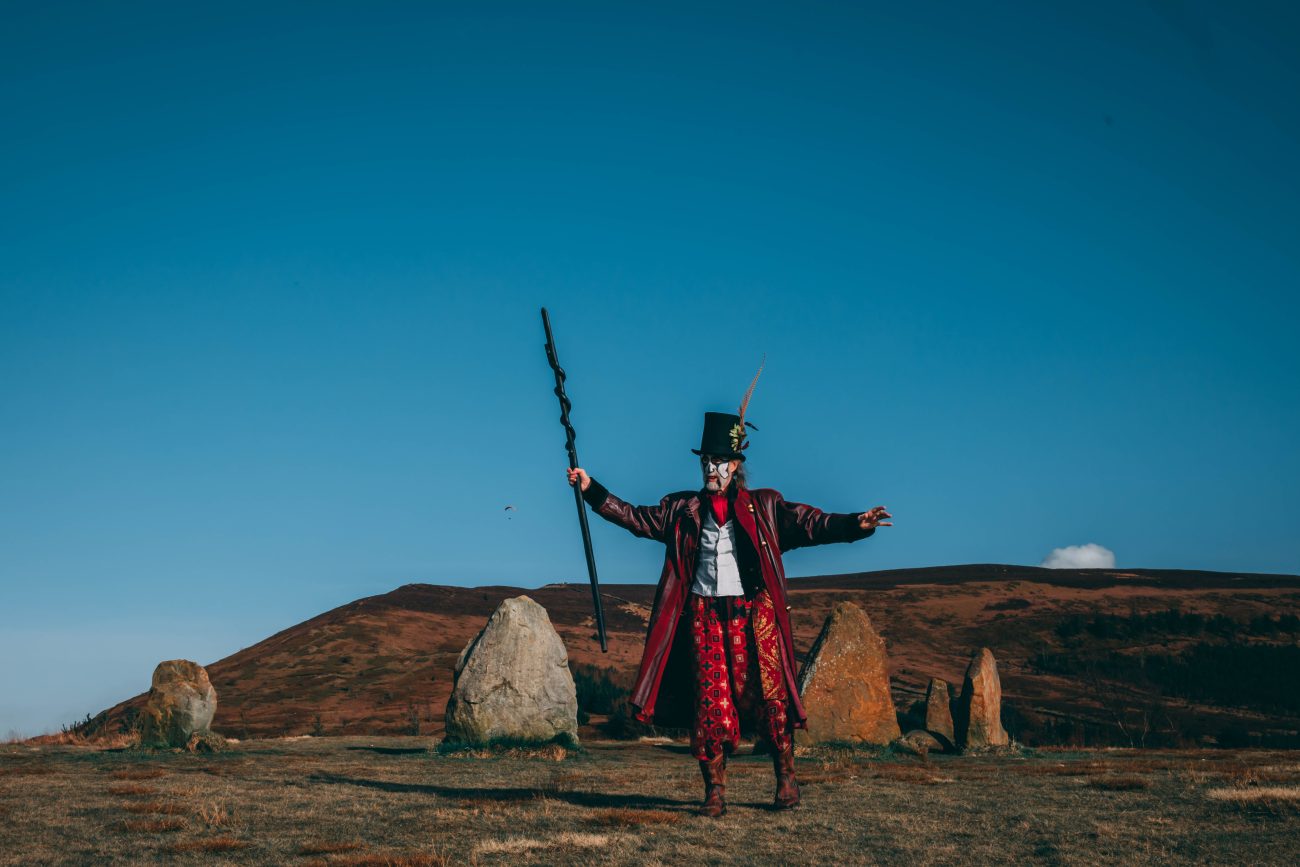
Just when the evening felt complete, the immortal legend and God of Hellfire himself, Arthur Brown, strolled out in his signature fiery top hat to drop a massive surprise, officially announcing next year’s headliner: Falkenbach.
The revelation felt like the fulfilment of a long-held dream for the crowd, sending a wave of electric excitement through the meadow. After the final drops of free beer were rationed out to thirsty attendees, the meadow closed down to prepare for the descent into the cave.
Of course, nature always demands its tribute. As Friday rolled in, the weather turned fierce with heavy rain and driving wind gusts, causing urgent campground warnings to properly secure tents against the gathering gale. Coupled with the usual late-night taxi scramble, navigating the journey back to our lodging was a bit of an adventure, but the resilient spirit of the festival prevailed and everyone managed to make it back safely in the end.
Friday – descending into the Balver Höhle
Moving from the meadow into the depths of the Balver Höhle on Friday brought a striking shift in atmosphere. As Europe’s largest open-hall cultural cave, stepping inside feels instantly humbling. This ancient limestone shelter was used by Neanderthals and Ice Age wildlife long before legends whispered of the blacksmith Wayland forging his weapons within these walls and music echoing through the stone for over 3,000 years.
Catching a glimpse of the venue during preparations – complete with atmospheric fog machine tests swirling against the chill of Thursday night – was a sight to behold.
So, returning to the cave on a rainy and windy Friday – after navigating a quick stop for coins/Wertmarken (WM) outside, which thankfully could be purchased by card – felt a bit like having found a protective shelter among many like-minded people.
As the elements raged, the festival grounds provided the ultimate comfort through their culinary options. With the food stalls officially opening for Friday and Saturday, attendees were treated to fantastic catering across the board.
The absolute crown, however, belonged to the dürüm. It was a quick yet savoury meal, exactly the kind of hearty, delicious fuel needed to combat the damp cold and power through consecutive days of heavy, demanding music.
I managed to secure my spot right as Farsot prepared to open the official first day of Prophecy Fest 2026.
Farsot
Operating behind their signature anonymous Roman numeral pseudonyms, East German avant-garde black metal veterans Farsot, fronted by the shadowy vocalist X.XIX, immediately locked down the venue’s mood with material from Life Promised Death. Their sharp, recognisable riffs and cryptic stage presence instantly saturated the stone walls with a bleak intensity that set a towering standard for the day.
Dold Vorde Ens Navn
With my spot held tight for Dold Vorde Ens Navn, I quickly noticed I was far from the only one waiting with bated breath. Having previously caught them during the day shift at Bergen’s Kulturhuset during Beyond the Gates, seeing this elite Norwegian black metal collective, featuring veterans like co-founder Håvard Jørgensen and their new frontman Simon Peter Hovind (aka Svik), dominate this amazing cave setting was phenomenal.
They delivered completely: the cave’s legendary acoustics played along like an organic, breathing member of the band, amplifying every complex layer. Before long, the room was entirely spellbound, making it deeply satisfying to witness them standing on a grander stage – deservedly so.
For me, the magic of this performance extended far beyond the stage lights. The day after the set, I had the pleasure of chatting with their bassist, Kai. He was an absolute gentleman and incredibly kind. He even recognised one of my previous reviews, so in a fun exchange of mutual respect, I got to give him a little sneak peek of my thoughts on their Friday gig before heading off.
Spiritual Front
After a short intermission, Spiritual Front was up next. Singer Simone Salvatori had already enchanted us the previous evening with his acoustic set on the meadow, and the presentation of the 20th anniversary of “Armageddon Gigolo” certainly carried us into another sphere. It was hard to feel nihilistic while being surrounded by so much class in the vocals.
Maunah
While Maunah delivered their atmospheric doom over on the secondary stage, the main-stage momentum kept rolling. Serving as their official “Hjarta” album release show, this set marked a staggering milestone: the young Danes’ very first live performance in Germany, booked straight from the label’s demo pile.
Playing completely unreleased material to an unfamiliar crowd is a daunting task, yet their raw, unpolished performance carried a striking, curious energy that immediately turned heads and left a powerful first impression on the early weekend crowd.
They did not disappoint. Their blend of traditional Nordic folk instrumentation and lumbering post-doom felt remarkably mature, casting a heavy, melancholic spell over the second-stage crowd. Their minimalist, sky-gazing despair proved that it carries just as much raw power in a live setting as it does on tape, establishing them immediately as one of the weekend’s most fascinating new discoveries and perfectly setting the stage for their second set the following day.
Dymna Lotva
As a passionate follower of depressive suicidal black metal (DSBM), I am naturally drawn to music that captures the absolute limits of human despair. Yet watching Dymna Lotva perform inside the cavernous depths of the Balve Cave felt like witnessing an entirely different dimension of sorrow.
While the band masterfully defines their own sound as a fusion of post-black and doom metal, their devastatingly raw performance carried a parallel emotional weight that instantly resonated with my DSBM sensibilities.
The difference here is that the agony isn’t an abstract exploration of internal depression; it is a direct conduit for real-world trauma. When frontwoman Nokt Aeon let loose her throat-tearing shrieks, transitioning seamlessly into haunting traditional Slavic folk laments, she wasn’t just performing – she was channelling tangible grief and emotion.
It was an exorcism in catharsis, so heavy and demanding that it completely contextualises why the members utilise the lighter, beer-soaked environment of their side project, Hangover in Minsk, as a vital creative escape just to stay sane after pouring such authentic torment into the microphone.
Empyrium
Bridging into Empyrium’s monumental performance celebrating 30 years of A Wintersunset…, the atmosphere inside the cave shifted towards pure reverence. This wasn’t merely another performance; it was an introduction to the roots of everything.
As the foundational blueprint of the entire “Prophecy sound”, hearing these three-decade-old compositions echo through the subterranean darkness felt like an emotional homecoming.
Label icon Markus Stock (aka Schwadorf) and Thomas Helm brought their peerless musical heritage to the stage with an almost sacred precision. The acoustic guitars, solemn keyboards and sweeping, nature-inspired doom melodies did not just fill the cave; they seemed to belong to it, as if the ancient stone had been waiting to catch these exact notes.
Outside of the performance, Schwadorf’s infamous backstage humour and warm hospitality had everyone buzzing, reinforcing the tight-knit family spirit that defines this festival. But inside the vault, under the dim stage lights, the music took on a staggering, monolithic gravity.
It was a deeply emotional tribute to the very roots of dark metal history, proving that the melancholy birthed in 1996 has only grown more profound with age.
Neun Welten
Over on the second stage, Neun Welten brought another slice of their signature dark folk magic with an exclusive, specialised metal set. Known for blending intricate acoustic fingerpicking, melancholic string arrangements and a dense pagan atmosphere, their performance offered a gorgeous, heavy expansion of their two decades of musical history.
Transformed for the cave, their typically delicate melodies took on a massive, driving weight that felt completely immersive.
Arthur Brown
Then came Arthur Brown, the eternal God of Hellfire himself, offering what was easily the weekend’s most brilliantly eccentric anomaly.
Celebrating his new release “Nature”, the octogenarian showman delivered an inspiring, ever-changing journey through the trippy, avant-garde corridors of rock history. His presence provided a stark, theatrical contrast to the surrounding extreme metal, injecting a refreshing dose of bubbly, unhinged vintage charm into the damp, cold environment.
At 84 years old, Brown possesses an untamed energy that would put musicians a third of his age to shame. Clad in striking face paint and shifting through a kaleidoscope of theatrical costumes, he commanded the stage like a mad psychedelic shaman.
His soulful, wide-ranging vocals bounced spectacularly off the ancient rock, turning the venue into a vibrant, swinging 1960s underground club. It was a chaotic, brilliant palate cleanser – a reminder of the raw, theatrical rock-and-roll DNA that predates modern extreme music, leaving the cave completely re-energised.
Tiamat
The solemn honour of drawing a heavy velvet curtain over the main stage on Friday night fell squarely to Tiamat. Anticipation hung thick in the damp air; this was to be an expansive, dedicated excavation of their 1994 masterpiece, “Wildhoney”, an album that historically severed the band’s ties with traditional death-doom to birth a hallucinatory, progressive realm of gothic psychedelia.
When Johan Edlund finally stepped into the dim stage lights, he cut a skiffle-like, delightfully eccentric figure, possessing a vocal command that felt remarkably robust, weathered and resonant.
Rather than a standard, paint-by-numbers anniversary set, the performance unfurled like a slow-burning subterranean ritual. The cavernous natural reverb caught every drifting delay pedal and synth patch, swirling them high into the dark stone ceilings until the boundary between the band’s instrumentation and the cave itself completely dissolved.
The sprawling, melancholic tapestry of tracks like “Whatever That Hurts” and the towering, iconic weight of “Gaia” did not merely bounce off the rock; they crawled through it.
Edlund’s signature delivery, a brooding crossroads between a deep, spoken-word incantation and a low, sinister gothic growl, carried an immense, ancient gravity. By the time the final chords melted into the night, the audience was left suspended in a state of quiet, monolithic hypnosis, stepping out into the autumnal air completely spellbound.