
Metal, Hardcore, Indie, Rock
“We envision creating heavy metal rooted in Indigenous philosophy” – Interview with Mawiza
If we think of a band that has introduced innovation to metal music, Mawiza is likely one of the first that comes to mind. Originating from Chile, Mawiza (meaning ‘Mountain’) aims to do something unprecedented: perform in Mapudungun, the language of the Mapuche Nation, thus decolonizing the sound of heavy metal. They deliver powerful guitar riffs, blending modern music styles with traditional stories from Wallmapu, the ancestral Mapuche land. Mawiza also seeks to empower Indigenous youth, who are caught between urban life and a desire to reconnect with their roots and lands. After releasing a few EPs under the name Nunca Seremos Dichosos (‘We’ll Never Be Blissful’), which addressed Latin American political issues, they changed their name and focus to highlight the resilience of the Mapuche Nation. Their 2019 piece, “Mawiza Ñi Piwke” (Mountain’s heart), was the first metal song fully sung in Mapudungun. Last year, they released their latest album, “ÜL” (‘Chant’), through Season of Mist, receiving widespread critical acclaim. This summer, Mawiza will begin their Nordic tour, including a performance at Hellsinki Metal Festival in Finland. We recently spoke with Awka Mondaka (Vocals & Rhythm Guitar) about their upcoming projects, the recent collaboration with Joe Duplantier (Gojira), decolonization in heavy metal, and how music can enhance bridges among cultures and generations.
Hello and welcome to Chaos Zine! What has Mawiza been up to lately?
Awka: Hi, thank you for the invite. Over the past few months, we’ve been working on our next album and also planning the upcoming European tour. We also had a concert in Chile in January, which went very well. It was a sold-out show, and we’ve never sold so many tickets in our own country. I think that’s due to the international reach we’ve achieved with Season of Mist, so it’s been a lot of work lately.
Let’s start with the basics. Who is part of Mawiza, and what inspires you to create your music?
Awka: Sure, let me introduce our lineup! We have Karü (Lead Guitar & Backing Vocals), Zewü (Bass & Backing Vocals), Txalkan (Drums & Percussion), and me (Vocals & Rhythm Guitar). Mawiza was formed by four Mapuche friends born in the city, each carrying two unique worldviews. Our goal is to honor ancestral wisdom while navigating the feelings of not quite belonging in urban life. We draw on nature’s teachings to promote harmony and coexistence, blending them with Western musical tools and instruments that are new to the Mapuche culture. The core of Mawiza is rooted in our Indigenous perspective—resisting, celebrating, and singing in a Mapuche style with a fresh urban energy. We hope to inspire our fans to feel connected to the land they live on and cherish their ancestral roots, as they were the original storytellers. Our lyrics are mainly in Mapudungun, the language gifted to us by the mountains and spirits of nature.
The band’s initial name was Nunca Seremos Dichosos (‘We’ll Never Be Blissful’), and at that time, your music focused on Latin American themes. When the name evolved to Mawiza, the band’s artistry changed to what we know today. Is your music a form of political activism?
Awka: Yes, definitely, the band has always had a strong political aspect. Initially, our goal was to create music that reflected our Latin American reality, without trying to sound like bands from the Global North. We believed that as ‘Latinos’, we had our own unique social and cultural context. At one point, as Nunca Seremos Dichosos, we focused too much on representing the entire Latin American region. Over time, we realized that the most genuine approach was to focus on ourselves rather than waving a Latin American flag, since the region is very diverse. Therefore, we shifted our concept entirely towards Mapuche culture. On our debut album, “Kollong” (2019), singing in Spanish helped us connect with the Latin American context, but the themes started to center on Mapuche resilience, especially in “Mawiza Ñi Piwké”, our first song in Mapudungun, which quickly transports listeners to a pristine, southern Latin American region.
Resisting oppression has been a core part of our journey from the very beginning, and speaking out against power structures has always been at the heart of who we are. Mawiza wouldn’t be what it is today without this deep drive to challenge injustice; we’ve also come to understand that Indigenous perspectives cannot be fully understood through a Western political lens. That’s why our work feels highly personal—because everything is political, every choice we make, and our music is closely tied to these issues. Our main goal is to inspire thought and invite criticism of the system.
The band has an innovative profile, mixing Mapuche instruments with narratives of resilience. Could Mawiza’s music be categorized as a new genre, or do you prefer not to use categorizations?
Awka: We love creating our own Mapuche style, but we’d prefer people to name it according to their own interpretation. Recently, on social media, we categorized it as “ÜL metal” or “Mapuche metal” to give it an Indigenous meaning. One of our aims as a band is to create such innovative metal that it could be considered a new subgenre. Although we’re not yet sure we’ve fully achieved it, that’s an ambition, grounded in Mapuche philosophy: recognizing sounds, asking what our ancestors heard, why Mapuche instruments were created, and what sounds of nature they imitate. We try to integrate all these dynamics and protocols for playing the instruments into our music, imagining that heavy metal originated in this land, Wallmapu. In our music, we materialize harmonies that imitate Mapuche wind instruments, which in turn seek to emulate birdsong. This Indigenous way of creating music is one of the pillars in Mawiza‘s artistry, but as I mentioned, we would like people to give it their own name.
Do you consider your music to be a form of decolonization from the injustices experienced by the Mapuche Nation?
Awka: The shared past of Indigenous Nations, including the Mapuche Nation, is a powerful story of resilience and identity. The Mapuche Nation proudly maintained its independence for over 400 years, resisting the conquest by the Spanish Empire. We existed as a nation long before becoming part of what is now Chile and Argentina, and over the years, we also adopted cultural elements of the “huinca” (wingka), a term for non-Mapuche people, including colonizers. Reflecting on our past, it’s natural to wonder how our ancestors arrived here, and in a way, this is a celebration of overcoming colonization. The relationship with the “wingka”, the outside world, appears in our song “Wingkawnoam“ (2025), which encourages us to decolonize our spirits — to believe in dreams rather than interpret them symbolically. Sometimes, dreams carry messages from our ancestors — spiritual messages that guide us. Decolonization is about reconnecting with and adapting our ancestral spirituality to today’s world. Though it’s challenging in this highly technological age, it prompts us to ask ourselves: “Am I a modern person or an Indigenous person?”, helping us find our way forward with a decolonized spirit.
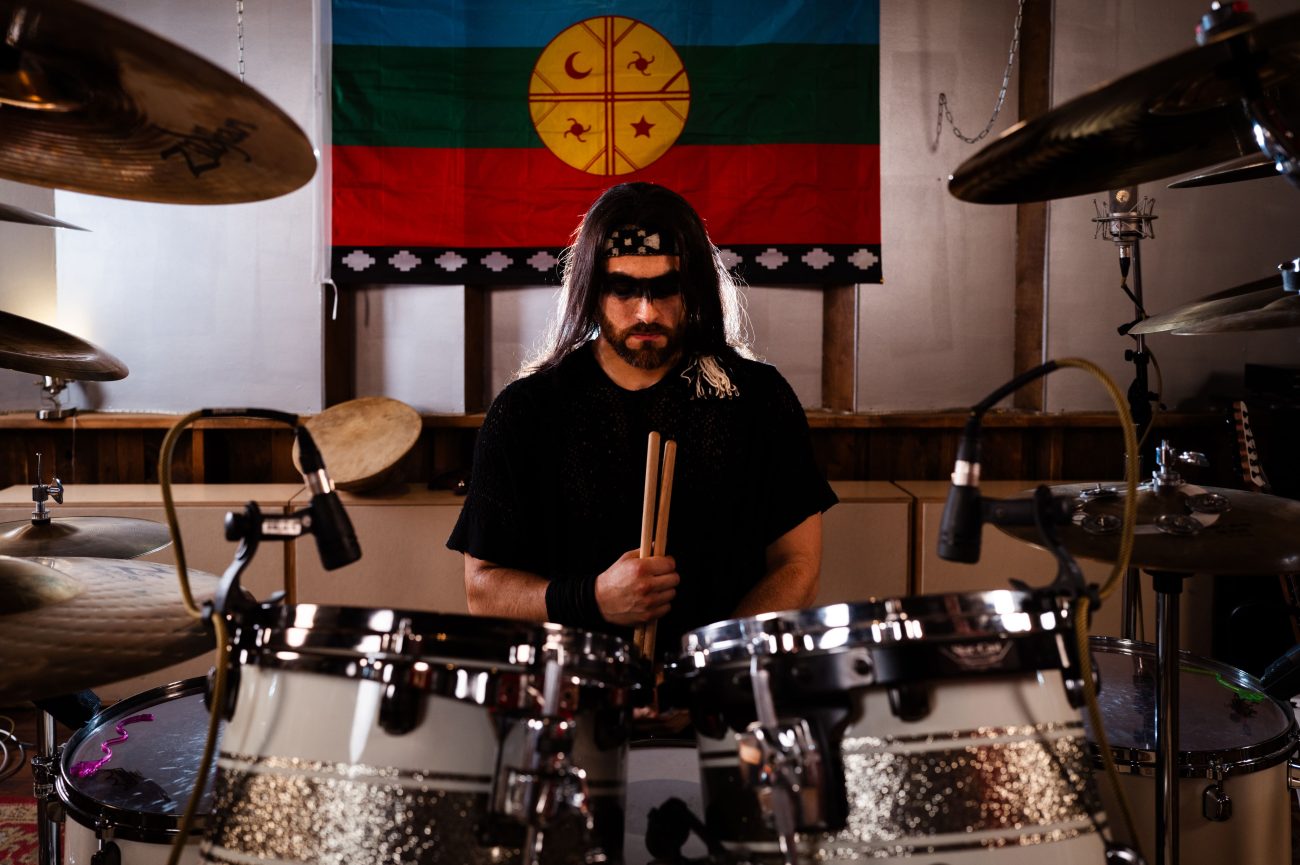
Txalkan (Drums & Percussion) at Silvercord Studios (2025). Author: A.F. Cortes Source: Neuplot Studio
You are the main composer in Mawiza. Considering that your native language is Spanish, how did you perfect your fluency and command of the Mapudungun language to compose the albums?
Awka: Mapudungun was a silenced language; speaking it was forbidden in schools, and my grandparents’ generation was ashamed to use it, failing to pass it on to their children. However, the younger generations have overcome that shame and persistently ask their grandparents for Mapudungun words. In my family, the language was lost, and although a few words remained in my grandparents’ vocabulary, it wasn’t enough to write a song. Therefore, when Mawiza was created as a Mapuche project, I had to learn it in depth. We managed to connect with some rural Mapuche communities that are more resistant to colonization and use the language daily. It was a quest to become familiar with the spirits of the landscape and awaken the language within us. As a result, our ancestors began to communicate with us through it. I also studied the language theoretically and was disciplined throughout the process. I hope our lyrics spark interest among the urban Mapuche community in reconnecting with their heritage. We share the same “newen“-the Mapudungun word for energy- through our music.
Since we’re talking about connecting with the Mapuche audience, would you like to collaborate with other Indigenous artists?
Awka: Yes, of course, we already have. A few years ago, we collaborated with the Mapuche rapper MC Millaray on the single “Txükür.” It’s a nü-metal style song, in which we combined Mapudungun with Spanish. The result was beautiful because we admire MC Millaray‘s political activism. We would also love to work with legendary Mapuche artists like Beatriz Pichi Malen, who is one of our most representative contemporary singers. In general, we are open to collaborating with any artist who shares our philosophy of life.
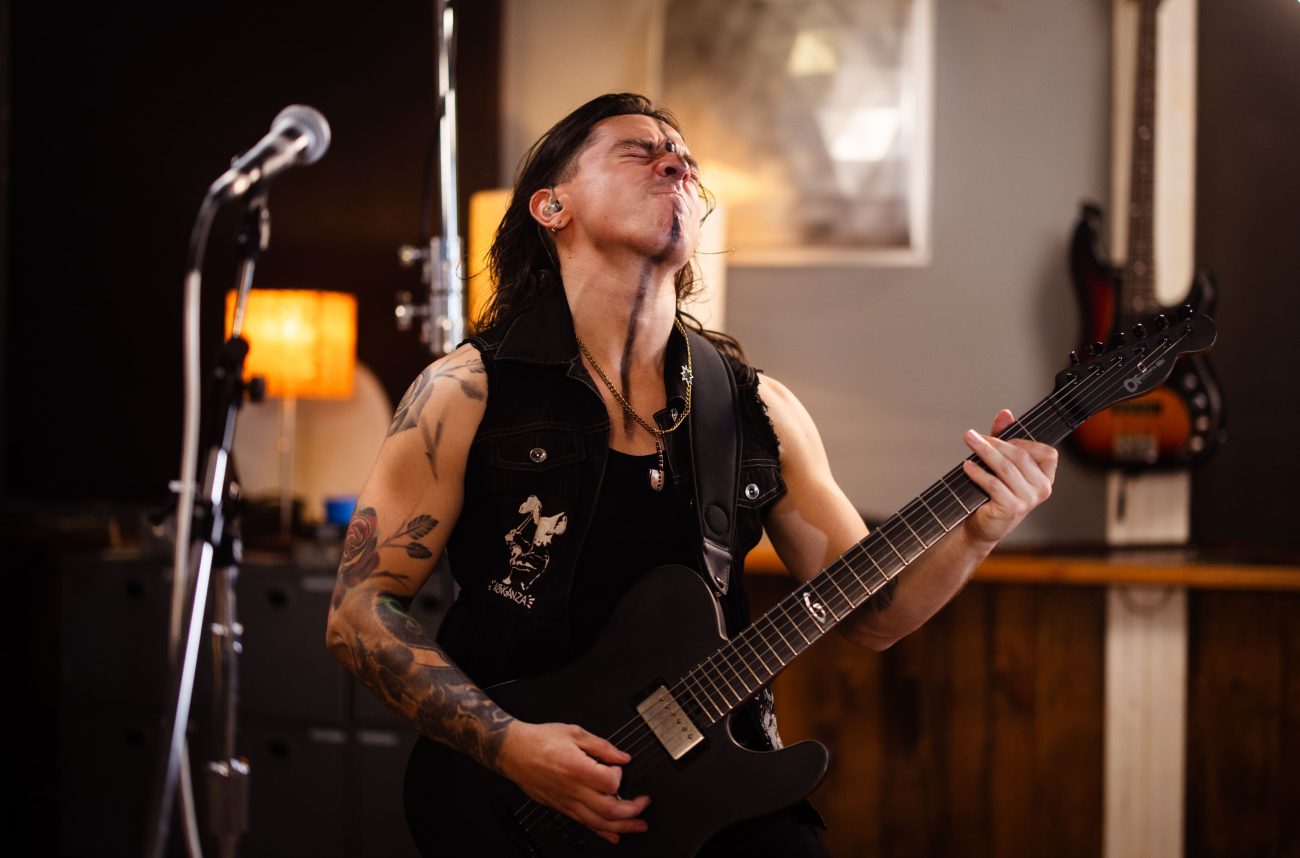
Karü (Lead Guitar & Backing Vocals) at Silvercord Studios (2025). Author: A.F. Cortes Source: Neuplot Studio
Mawiza’s latest album, “ÜL” (2025), has an interesting sonic approach. I felt a connection between the songs and that there’s a story behind them. Is this a concept album?
Awka: The band never considered creating a concept album, but you raise an interesting point: “ÜL” has a strong sense of immersion. From the beginning of the creative process, one of our goals was to convey a spiritual feeling, so all the songs share certain elements; some musical arrangements are repeated throughout the work. Although the main focus was spiritual, we also felt the need to include a “hit song.” While recording the album, we discussed the lack of a simple song with two choruses and a three-minute duration. Hence, we chose to include short tracks and play with that strategy within this sonic experience.
I wouldn’t consider this to be primarily conceptual in the sense of defining a narrative goal with characters; it doesn’t go in that direction. However, all the themes arise from the same angle, a spiritual position. Many people might think that by saying “Mapuche Nation” we would always be talking about a single theme in our songs, but in reality, such a worldview is so broad that it allows for diverse forms of expression. Currently, we are working on the structure of the next album, which will also convey a specific feeling. We aim to release it in 2027.
One of “ÜL”‘s highlights is the collaboration with Joe Duplantier (Gojira). How did the idea come about and materialize?
Awka: Our professional relationship with Joe began when Gojira played in Chile in 2022. Mawiza’s management had already been in contact with the band, having booked them for a concert in Spain during their early years.
In 2022, just before Gojira visited Chile, we were in the early stages of recording the album “ÜL.” That year, we uploaded a cover of Metallica‘s “Battery,” titled “Awükan,” to YouTube. Before releasing it, we sent it to Joe through our management, and he liked it so much that he asked us to open for Gojira in Santiago. He mentioned to us that the cover had a fresh sound.
The following year, Gojira returned to Chile for their “The Mega-Monsters Tour” with the same local concert promoter, who again invited us to open. This second time around, we were able to interact more with Joe and exchange ideas. We discovered several shared interests, especially regarding veganism—since some band members and Joe are vegan—and the protection of Indigenous territories. Gojira maintains a close relationship with Amazonian communities, and even their album “The Link” (2003) includes a song called “Indians.”
On that occasion, we invited Joe to our Mapuche community, located near Santiago. The visit took place the day after the concert. We told him we were recording our next album and asked him to participate in a song, and surprisingly, he agreed to collaborate. That same day, after visiting the community, we went to our studio in Santiago and recorded the vocals for the track “Ti Inan Paw-Pawkan.” As most of the song includes repetitive vocal sounds in Mapudungun, it was relatively straightforward to record. Later, he invited us to record a live session at his Silver Cord studio in New York, which was released in 2025. We hope to continue collaborating with him in the future.
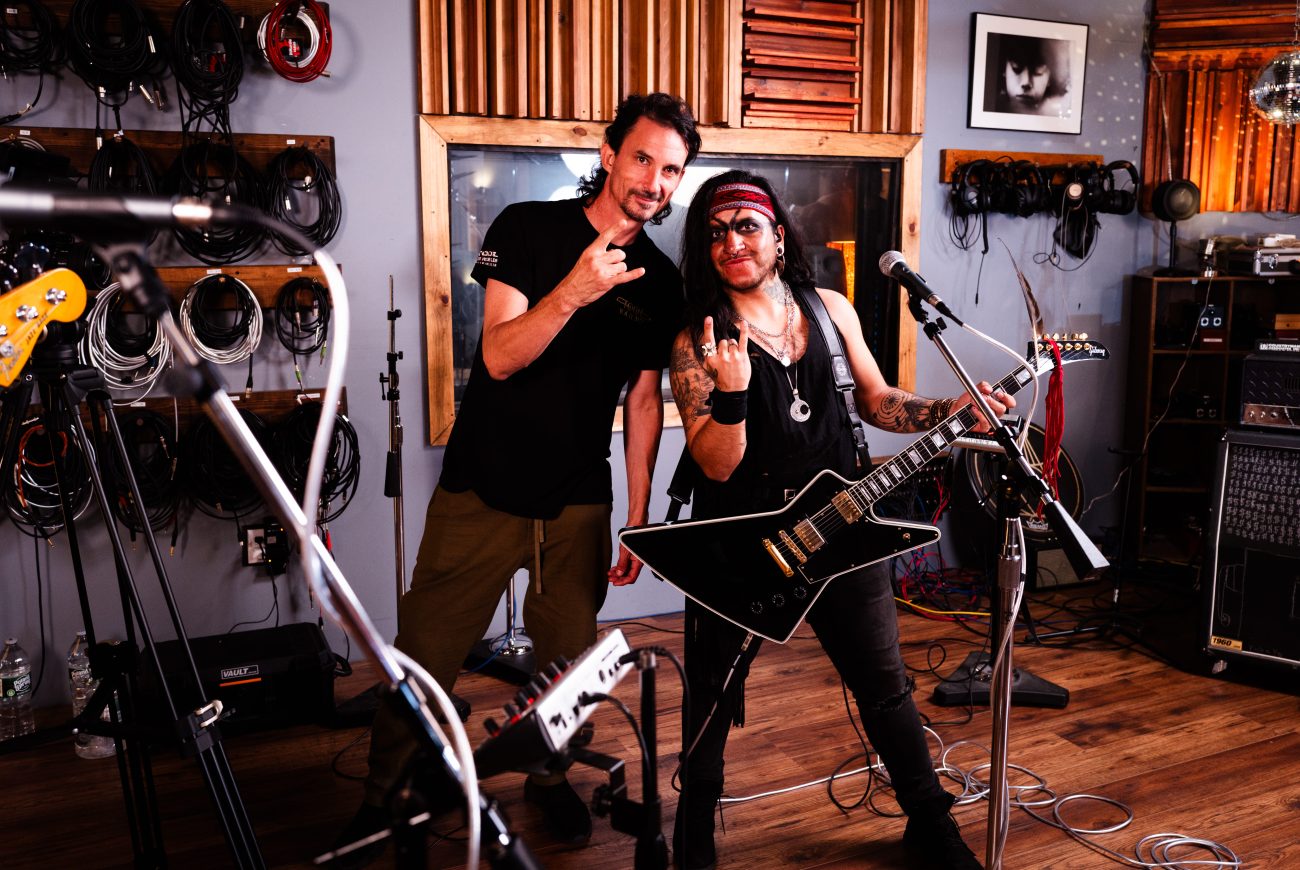
Awka Mondaka with Joe Duplantier at Silvercord Studios (2025). Author: A.F. Cortes Source: Neuplot Studio
So, everything happened very spontaneously.
Awka: Yes, it did happen all of a sudden. Joe showed great energy by taking the time, in the middle of a tour, to get up early and visit our community. When you visit a Mapuche community, it’s important to arrive right at dawn as a sign of respect, since the sun’s movement guides our activities throughout the day. The night before, Joe had a concert and surely went to his hotel to rest very late, and yet he still woke up a few hours before sunrise to visit a community unfamiliar to him. We are very grateful for his interest in experiencing our culture.
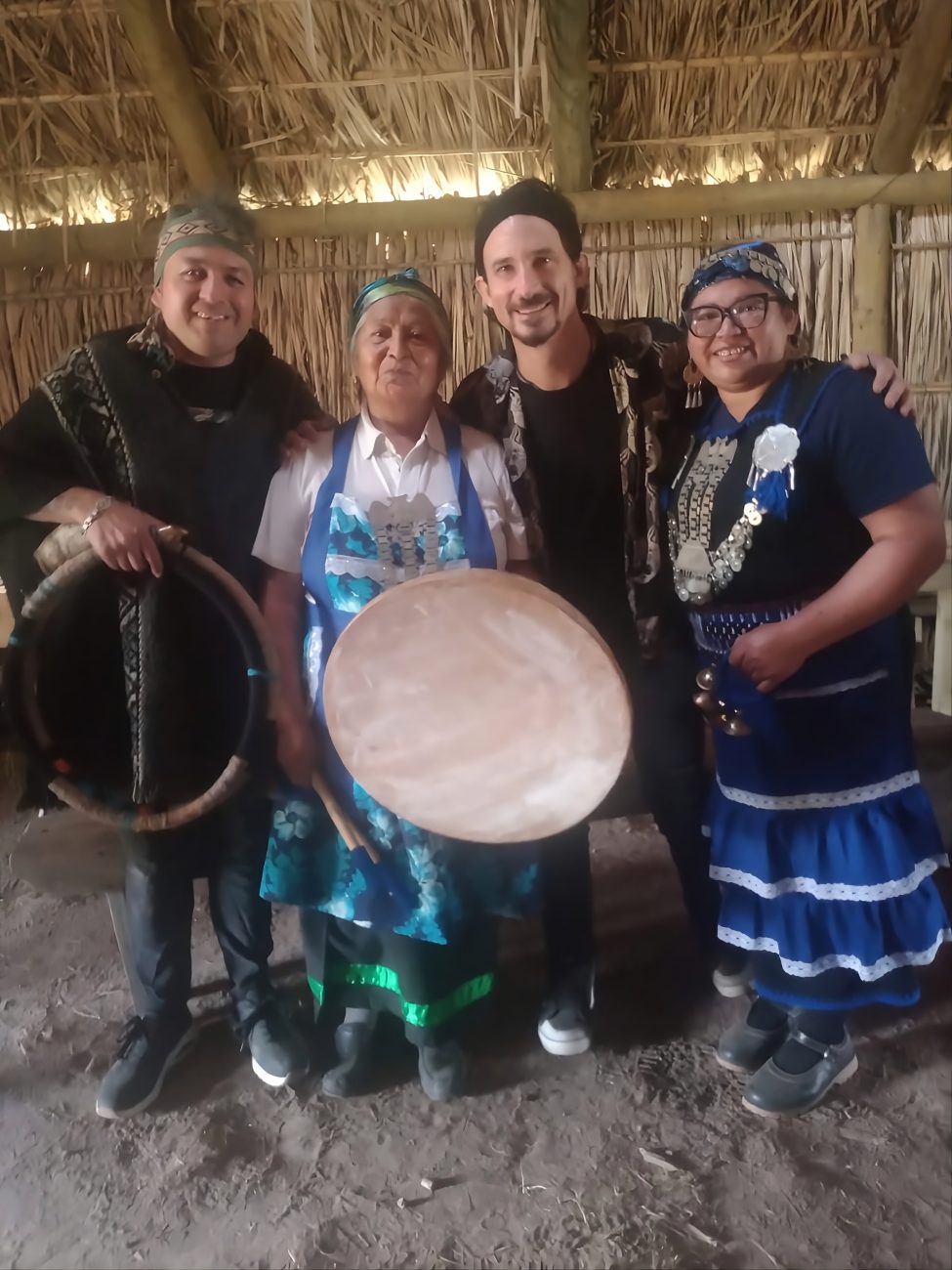
Joe Duplantier while visiting Mawiza’s community (2023). Photo provided by Awka Mondaka.
What are your expectations for Hellsinki Metal Festival and the European tour in general?
Awka: We will be performing at Wacken Open Air in Germany, Hellsinki Metal Festival in Finland, some concerts in Sweden and Denmark, including Malmö Massacre Festival, as well as participating in Midgarsblot Festival in Norway. Although we have toured Europe before, this will be our first time in the Nordic countries, which we are very excited about. In serving these lands and their ancestors, we present ourselves as musicians from Wallmapu and offer our work as a gift. Although Mapudungun is a minor language with few speakers, we hope Mawiza‘s music will convey its spirit.
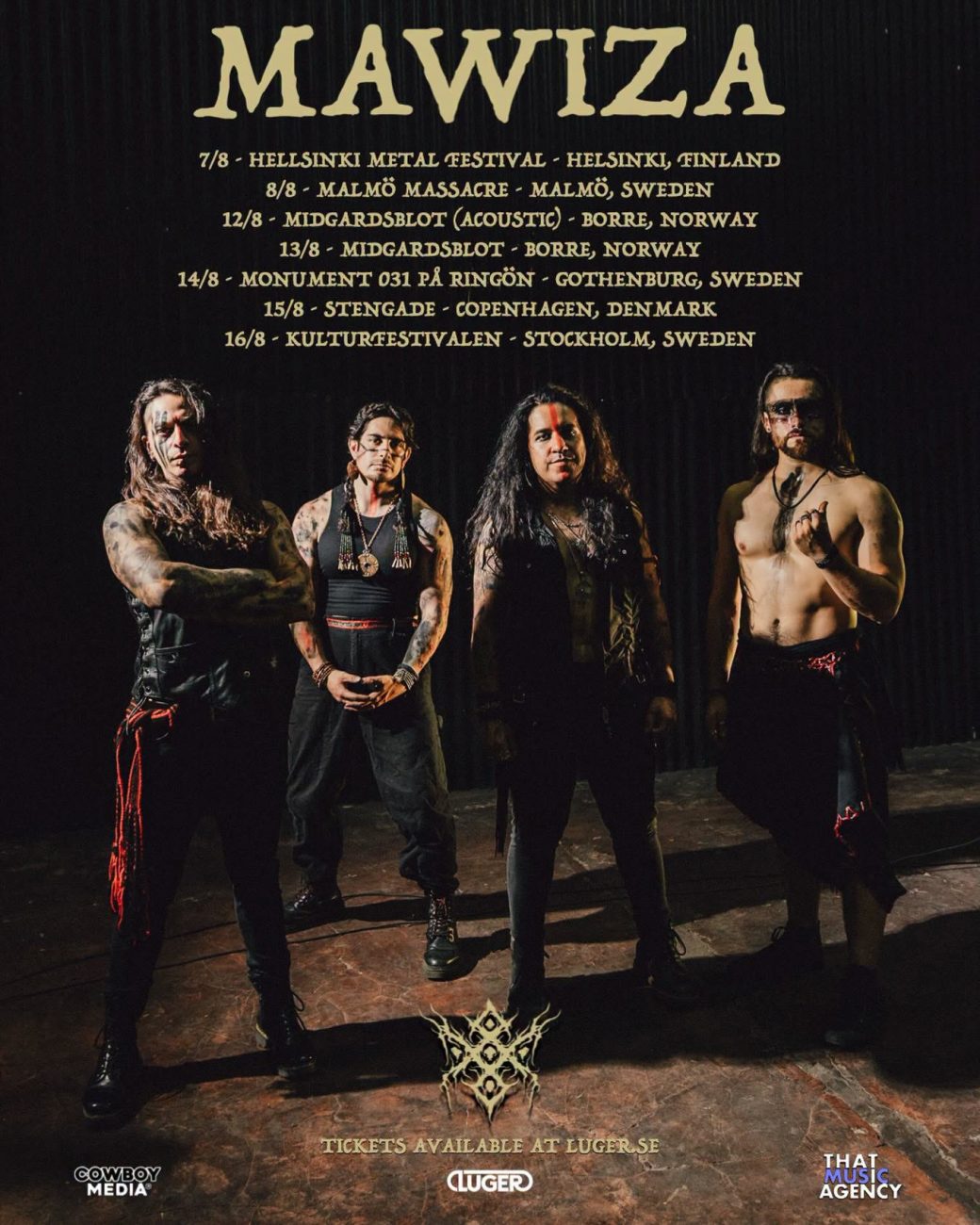
Mawiza’s European tour dates (2026). Source: Luger Sweden
To wrap things up, would you like to tell us about your future plans?
Awka: Thank you for having us. Stay tuned for our tour this summer because we’ll have different sets: one electric with more energy, and another acoustic, with a more traditional and intimate atmosphere. We also just released “Mür” (‘Together’), with Mira Ceti (Heilung) and Anne Olsen (Danefae), while promoting our upcoming concerts. You can find more updates on our social media channels.