
Metal, Hardcore, Indie, Rock
“We want to play songs that resonate with you” — Interview with Drillhead (Argentina)
It’s the end of March, and on the other side of the screen is Alejandro García, better known as Drillhead. Hailing from Argentina’s emerging nu-metal scene, he has made a splash with the release of his new single, “Vive Tu Vida (Como Lo Quieras Hacer)”. Blending the sound of bands like Korn and Static-X with samples and industrial keyboards, it achieves a fusion of classic nu-metal with a modern urban aesthetic.
A producer and multi-instrumentalist, Drillhead — also known as Mister Prodigy — has made steady yet sustained progress with compositions that reveal a wide range of influences, including those from outside the metal genre.
The aforementioned single “Vive Tu Vida (Como Lo Quieras Hacer)” achieved an 80% retention rate on YouTube, a far above-average engagement metric for the independent scene. To get to know the artist in more detail, Chaoszine spoke with Drillhead in the midst of the Argentine autumn:
How and when did Drillhead come about? What was the initial idea?
Drillhead came into being in 2024 when I, Alejandro García, decided to develop the idea that had been going round and round in my head: to form a nu-metal band with industrial and electronic influences, and touches of other metal genres. I posted an ad online saying ‘musicians wanted’, and before long, a drummer and a bassist came forward to bring the project to life, which took shape as follows: myself, Alejandro, on vocals, guitars and samples, with the drummer and bassist in their respective roles. The name Drillhead comes from a name I’d had in mind for many, many years and which is registered in my name.
I know there were several changes to the line-up after that, which led you to decide to embark on a solo career.
Yep, after many changes in the line-up and the departure of many others, I decided—as the owner of the name—to continue as a solo project, having grown tired of searching and of people not pulling in the same direction. I should clarify that I made all the recordings myself on all the instruments from the very first song, and that I spoke to the musicians to let them know about the project and introduce them to those recordings; several songs from the early days were composed by the whole band (that needs to be said), but I was the one who took charge of recording them on all the instruments, mixing them and mastering them, whilst keeping in mind the ideas of each of the members.
You always had a big-picture view of the project, which was very helpful.
Indeed. We were also concerned about sounding the same as on the recordings, so as not to be a fraud to the people who want to listen to us; everything I’ve ever recorded on my part was just me sounding as I do, with no artificial tricks involved; I do the same with the vocals– my vocals are practically unprocessed in those recordings. So that gave us the confidence that “we sound live just like on the album“, and the band is what it is, without the need for hyper-expensive gear and mega-processors to mask any shortcomings. And so, after giving up on looking for more musicians, my solo career began as Drillhead, my nickname.
Your influences come from nu metal, industrial and other subgenres. But it’s clear that you’re an eclectic musician – am I right?
Absolutely. My influences come from bands like Crazy Town, one of my favourite nu-metal bands with a more rap-oriented sound. I also draw inspiration from Limp Bizkit and HED PE., as well as Slipknot, who inspire me to incorporate blast beats and death metal techniques.
What else?
Coal Chamber has influenced me with their ‘madness’ and that weird, crazy world, as has Korn. My other influences come from my earlier days listening to thrash metal – my style is purely thrash, as I’m a huge fan of James Hetfield (Metallica) and Eric Peterson from Testament. I also love hardcore and try to make my guitar sound as ‘core’ as possible in the style of Agnostic Front or Biohazard. As a DJ, my biggest influences come from DJ Lethal of House of Pain and Limp Bizkit. I think he places samples exactly where they should be, and they always fit the atmosphere of the song and come at just the right moment. DJ Terminator X from Public Enemy is also a master of the decks, as is DJ Product from Hed PE.
Wow, there are a lot of influences!
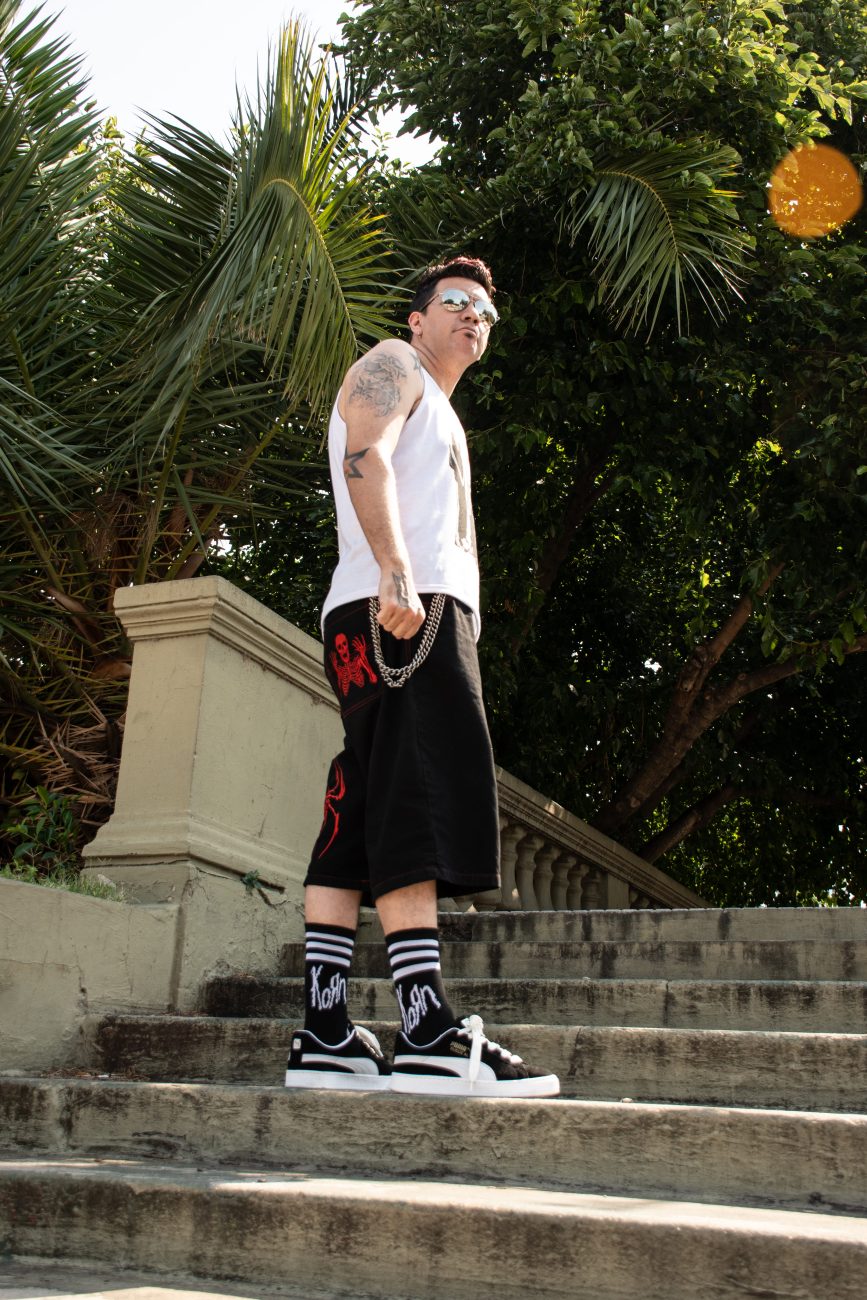
Yep. When it comes to electronic beats, I’d say that The Prodigy and their DJ, Liam Howlett, are my biggest influence – that’s where my nickname, ‘Mr Prodigy’, comes from. Keith Flint has also inspired me with the sheer energy he brings to the stage. As for my vocals, I can do growls in the style of Chris Barnes (formerly of Cannibal Corpse). I try to develop my own distinctive voice, but the vibe is always somewhere between Max Cavalera (I’ve got an ‘S’ tattooed on my arm), Wayne Static, Corey Taylor and Andrés Giménez from A.N.I.M.A.L., who has been one of my biggest influences since I was young. Most of the time, though, I try to “sound like myself”. As far as I can tell, my influences when it comes to rapping are Chuck D from Public Enemy and Flavor Flav, as well as Shifty Shellshock from Crazy Town.
You really are eclectic…
Just imagine that I’m also a salsa and merengue trumpet player! Haha! To top it all off, my sound is influenced by Dua Lipa’s band. The songs produced by the legendary music producer Nile Rodgers for Dua are one of my influences. The members of Obituary love ABBA, so why shouldn’t I have influences outside of metal and rock? The Spanish-English thing comes from another great band for me: Fun People, who have been essential to me since I was a kid. I’m thinking of writing songs in Spanglish at some point. I’m also thinking of including a Diaguita ocarina, which I bought here in San Telmo from someone, in a more atmospheric or introspective song. So yes, I’m an eclectic musician (laughs).
What are your plans for 2026?
This year, I’d like to find like-minded musicians, so we can work together to turn this big dream into reality. We’ll be touring to showcase our talent, delivering performances that capture the essence of our recorded tracks. Our audience should expect an energetic concert full of intros, samples, and powerful guitars. In other words, we want to play songs that resonate with you, that make you feel connected to our stories. You’ll sense the mix of tracks designed to move you, and you’ll think, “These guys are going through the same things as me“. Then there are others designed to get you into the wild mosh pit and let out your pent-up frustration with songs like “Fiesta Metal Fiesta!!!”.
The idea is that you can be part of the experience and make it your own.
Exactly. Of course, I also plan to continue promoting my newly released album and then, after a while, start releasing new songs. I’ll be performing many songs with English lyrics in Spanish and vice versa. This will help my message reach many more places and spread further afield. As we all know, English is the universal language.
How do you plan to adapt the solo format for live shows?
First and foremost, as I said before, it’s about finding musicians who want to sound just as good live as they do on the album – that was always the original idea – not selling them one thing and then sounding terrible and completely different from the recordings. I’d sing and play guitar just as I did in my early days with Drillhead. I’ve had a pedalboard custom-made to trigger samples and handle the DJ stuff live. I’d love to take charge of the guitar again so the essence of the original recordings comes through live, with the same sound, tone, techniques, etcetera.
Go on…
Also, the idea would be to include real keyboards so that it isn’t just ‘keyboard samples’ that are heard, and then, of course, a good acoustic drummer and a good real bassist as well. And most importantly, above all else: to be a musical family and not just a group where people turn up, play and leave without further ado; the idea is to forge genuine friendships, share barbecues and beers, and attend other bands’ gigs to further strengthen the musical connection and cohesion—something which (as far as I’m concerned and in my own opinion) couldn’t be achieved with session musicians.
More about Drillhead here.