Metal, Hardcore, Indie, Rock
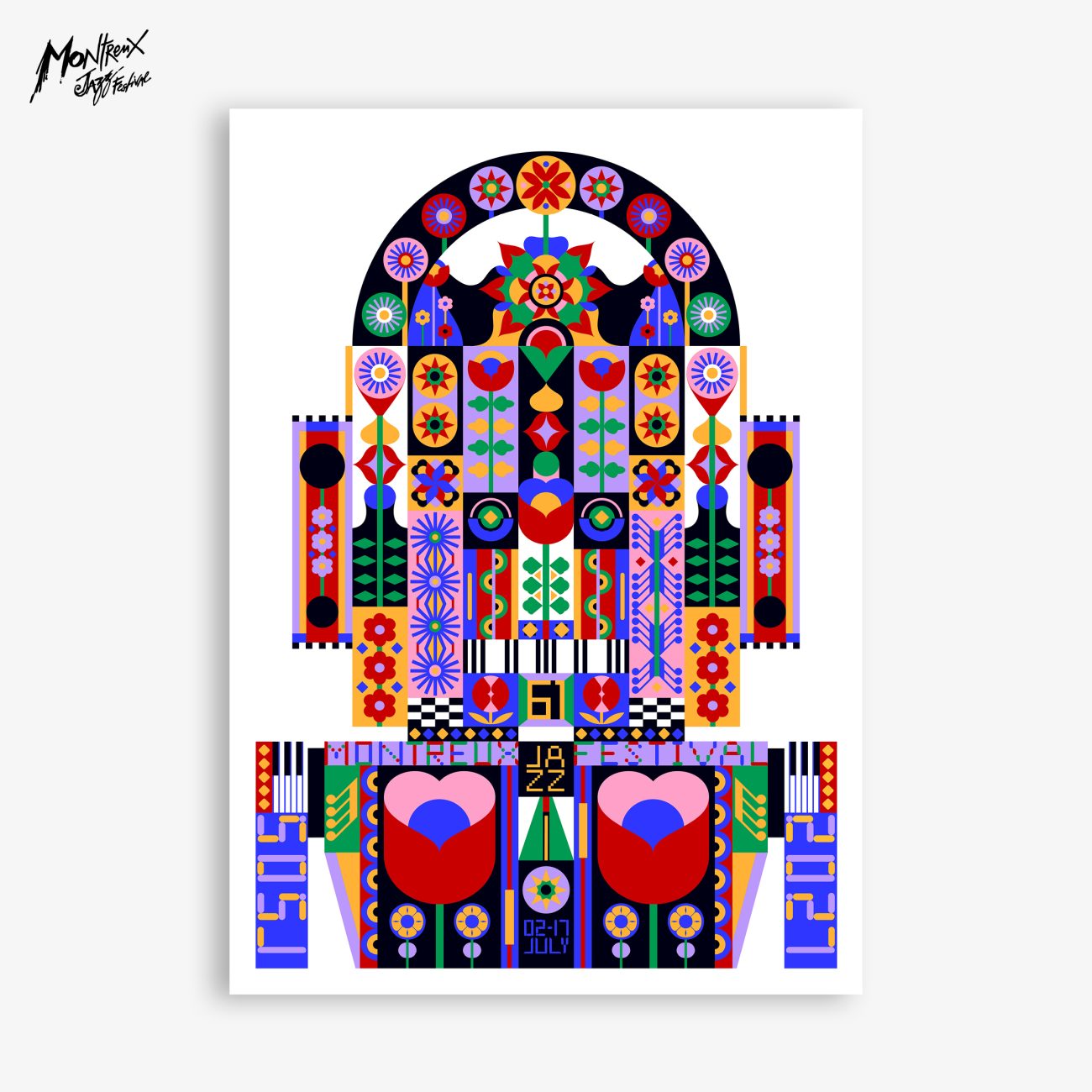
Montreux Jazz Festival today reveals that celebrated artists Malika Favre and Kumkum Fernando have joined forces to design the poster for its 61st edition, which will take place on the Lake Geneva shoreline from 2 July to 17 July 2027. Two pairs of eyes are sometimes better than one and this is only the second poster to be co-created by two artists in the rich history of the festival after Keith Haring and Andy Warhol’s iconic offering in 1986.
A decade ago, French artist and illustrator Favre fashioned one of the festival’s most popular posters, a sleek interweaving of female dancers and hidden musical instruments. To mark the 10th anniversary of that initial collaboration, the festival suggested she follow in the footsteps of Haring who, for his second poster, invited Warhol to join him. Favre, known for her striking use of geometry and playful optical illusions, jumped at the chance to work with Fernando, a Sri Lankan-born sculptural artist who is inspired by South Asia and retro-futurism.
“I fell in love with the festival on my very first visit in 2017. The poster I created for that edition remains one of my personal favourites to this day. I knew it would be hard to match, so I wanted to take the opposite approach: to create a work bursting with colour, as maximalist as the first one was minimalist. Kumkum was the ideal artist for this,” Favre explains.
Proving to be a dream double act, the duo’s dazzling poster exquisitely blends a retro-futuristic aesthetic with a flower power spirit. They drew from diverse eras, specifically ancestral South Asian traditions, retro-futurism and sixties hippie counterculture, to concoct a timeless, almost divine entity that symbolises music as an all-encompassing, intimate, spiritual, universal journey. A plethora of patterns, infused with florals, folk art and sensuality, adorn an enigmatic figure adopting the forms of a robot, altar and jukebox.
“The spark came when we noticed the resemblance between the shape of certain religious altars and that of a jukebox, both sharing the same sense of symmetry. We imagined a kind of gateway into a sacred realm of music, a timeless entity, part retro-futuristic robot, part mythological being, that embodies music as a joyful, universal experience,” Fernando says.
Rendered in multiple shapes and colours, the flowers in the design evoke the lakeside quays of Montreux and the flower power movement of the hippie era. Favre has a penchant for folding dual meanings into her art, and this time the floral patterns subtly outline lips, kisses and female faces, symbols of love, pleasure and sexuality that permeate her artistic universe. This blossoming of the senses, uniting physical and musical pleasure, also neatly nods to the fact that Montreux Jazz Festival was founded during the 1967 Summer of Love.
“I had this vision of music blooming in Montreux, this feeling of the entire town coming alive during the festival. I wanted to convey that joy. The world is going through strange times, and a festival like Montreux is an opportunity to celebrate. For me, flowers also symbolise eroticism, an explosion of the senses and the pleasures found in music. I always like to tuck in something a little cheeky, and I thought I could bring that touch of a feminine sensuality. When I sent the first flowers to Kumkum he said, ‘Oh yes, that’s sexy!’” – Favre adds.
From the outset, the idea was also to bring the poster’s central ‘entity’ to three-dimensional life, in keeping with Kumkum’s trademark practice of producing futuristic, geometric sculptures. It thus takes the form of a bespoke made-for-order vinyl cabinet boasting a dedicated turntable compartment and pull-out drawers for record storage.
Since its inception, Montreux Jazz Festival has given free rein to Swiss and international artists to create its official poster. In 1982 Jean Tinguely left an indelible mark with a design that became the festival’s iconic logo. Keith Haring created three versions in 1983, followed by his collaboration with Andy Warhol in 1986. David Bowie took part in 1995 as did, more recently, Yoann Lemoine (Woodkid), Christian Marclay, Lakwena and Kévin Germanier.
Malika Favre is a French artist and illustrator whose instantly recognisable aesthetic has established her as one of the most distinctive voices in contemporary illustration. Born in Paris, she lived in London for nearly two decades before moving to Barcelona, where she is currently based. Her work explores the interplay between positive and negative space through bold colours, striking geometry, and a playful use of optical illusion. Her visual language, both minimalist and sensual, has led to collaborations with some of the world’s most prestigious publications and brands, including The New Yorker, Vogue, The New York Times, and Penguin Books. Alongside her artistic practice, she is the co-founder of The Bazaar, a curated platform celebrating independent designers, artists and creators worldwide. Recently, her very first cover for The New Yorker was selected for the monograph commemorating one hundred years of the magazine’s covers.
Kumkum Fernando is a Sri Lankan artist whose work bridges ancient mythology and imagined futures. Born in Sri Lanka to a father who collected antiques and curiosities, he grew up surrounded by objects, stories, and traditions that continue to fuel his creative universe. Drawing inspiration from Sri Lankan heritage, South Asian mythology and the rich visual cultures of Asia, he reinterprets traditional forms through bold colours, geometric structures, and a future aesthetic. Equal parts ancient idols and science-fiction characters, his sculptures inhabit a world where the sacred and the fantastical coexist. Kumkum is the founder of REBORN, a creative studio exploring the intersection of art, design, and traditional craftsmanship through sculptures and collectible objects.